Be Prepared
An interesting week this turned into. It started with a productive trip to a transmitter site and ended with a visit from the FCC. In the middle, well actually around this was a visit from our corporate officers and a Harris Flexstar update.
The transmitter trip was to our Aux site. In preparations for licensing we did some new remote control wiring and posting of CPs. We discovered a bad switch on the RF load, so a new one will be installed next trip. The cable bridge is still wonky and I have no idea on the repair time frame.
We had a compliance inspection from our friendly FCC. If you are prepared why be worried? We passed with flying colors and I think the inspector was taken by our nonchalance and jovial confidence. Folks, it is not that difficult to maintain EAS compliance. Run the damned things and log them. It helps when a computer does the logging. The public files is the same thing. Get a check list and start making folders and fill them with the appropriate information. Some use binders. Some scan it all and make it available online. Any way you do it, just do it.
Last night I got hit with another mysterious Harris Flexstar outage. My remote reset connection came in handy. After a nice discussion this afternoon we may be testing some more. I am so curious about the cause that I am over the frustration part, though programming has other thoughts. I am at the point where if I do not know the cause I will be disappointed. From a business side we wish we could just replace it. In any case we march forward.
Be prepared for that which you can be and within your means. Try to enjoy the adventure.
Cheers!
When Being A Tenant is Not Fun
I uploaded to Twitter a picture yesterday of a site we visited yesterday. Unfortunately this is where our Aux transmitter is. For all I know the management/owner does not know of the damage. If I can figure out how to embed a couple more pictures here I would. Basically I have left a message on a cell phone and an office regarding the situation. The latest storms broke the guy wires to the vertical supports to the cable tray that runs between a tower and the building. The tray buckled. It is still there and there is stress on the cables. One 7/8″ cable is to our STL dish. Luckily we had enough “service loop” on the building end that the cable shows no damage and we continue to receive good signal.
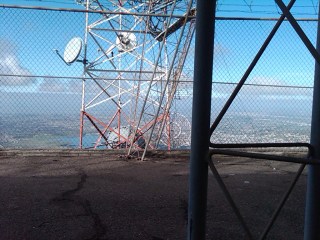
Vertical Support?
Why would a company, known tower/site management company, not respond to such a situation? I am prepared to make a couple of more calls, but this is the not the first time they have not returned a call. Just crazy.
As you can see in the picture here the supports are leaning here. You cannot really see it, but there are two in the center section that where held in place by two guy anchors.
The tray buckled as can be seen in the next photo.
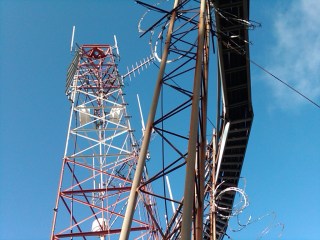
Buckled Tray
It sure isn’t pretty, but it is holding for the time being.
I would have to say this support structure has been here a while. I know it it was in in place 10 years ago. I bet it goes back 20 years. I would say repairs and upgrades are necessary. What do you think?
Marantz PMD570 Firmware Update
I had the opportunity to upgrade the firmware of our compact flash recorders this week. All in conjunction with a new morning show and the fact you cannot find many CF cards less than 2GB. Even a 4GB card was not read. After a check of the D-MPro website, I was a bit miffed that the machines needed to be sent in. After a kind email to technical support and a confirmation that I was “tech savvy”, they allowed me to download the necessary files and application to install the update. Thanks!
I proceeded to do the installation. I can tell you right now that the process is not “easy” or for the weak of heart. Actually, it was not too bad, but I can see why they recommend shipping the unit to them as the update application they sent is fairly complex. Out of respect, I am not at liberty to name the application except to say it is a developer toolkit. Just knowing that you may guess at how you can get into trouble.
I followed their instructions to the “T” even when the screen shot was in Japanese! I pushed the two updates, one for the microprocessor and one for the DSP. I did 4 machines and all of them behaved. I also discovered what the little, recessed switch is next to the RS232 DB9. The combination of stuff could get a novice in deep “S”. Each machine took at least 10 minutes to complete as loading the one update, for the MPU, took the most time and the special application. The DSP update was quick and was actually read from a CF card making that portion of the update easy.
Thanks again for trusting I would not screw up D-MPro Tech Support!
PS- if you have the DN-C640 CD players, there is a firmware update that corrects that “disk error” message when one does not exist.
Updates & and New Morning Show
Wow, has it been that long since I posted? For all 3 of you who follow diligently, thanks for staying tuned. It has been wild to say the least; if you follow my Twitter you have been up to date without details. We started a new morning show, and what comes with a new morning show is what we all expect: Headaches! If only they gave us time to prepare for their arrival. Where would the fun be in that, eh?
First surprise is that it is a talk-it-up show with 5 people. Nice. We have not had a talking-heads type show here in years, so we only have the basics in place. As we are a “if it ain’t broke, don’t fix it” mentality here on equipment that works, we do not update it. We’ve been caught too many times with updates that bit us in the ass. This one was better, though we did find you can mess up the whole system briefly with a “server” crash. Being talk, we had to integrate the Assistant Producer call screening software from Telos into the mix. We use the 2101 system. We found you can choose a Show/Studio combination with it such that if that combination does not exist in reality, it barfs the hub/server briefly. A call to Telos confirmed the older software was to blame. Time to upgrade after how many years?
After a little preparation and another call to Telos, we figured out the best procedure to upgrade the 2101 Hub and Studio I/Os to the latest and greatest; an upgrade released 3 years ago! I figured I would try to do each I/O via the front panel and quickly ruled that out. Telnet is the way to go. I have to say the update was smooth and all I/Os and Hub are up to date. I got the latest release of the Assistant Producer software and away we went. Well, until we discovered that we once again are able to choose a Show/Studio combination that make the AP application drop connection with the server. At least the whole system did not go down. As we now know the situation, we happily run AP.
As an added feature, we purchased an wireless VGA “extender” so the Assistant Producer computer in the air studio can be viewed on our 32″ LCD T.V. With a little font enlargement and making the entries bold, it works pretty darn well.
I think I may review the microphone the talent requested time permitting. It is a Blue Blueberry microphone. My first impression is it sounds good, though ascetically it is a bit ugly for me and bulky. It is paired with an Aphex 230 voice processor. As the main microphone is a Neuman BCM-104, I find there is not much difference between the two with this guy’s voice. Part of this is he seems to know how to work a good mic. It turns out the Blue mic is more expensive, too. So much for the budget!
Carry on!
Harris FlexStar Issue
I mentioned awhile back that we were having mysterious outages, or off-air events, with our HTHD+ transmitter. This began May or June last year and we’ve spent much time working with Harris to determine where the problem was. Each time we would try or look into something as they suggested. The events were random and quite annoying. Obviously the station PD was becoming quite annoyed. Random issues are the worst.
As we followed suggestions, we connected the remote control to various status and metering locations to determine what and where our RF mute was occurring. We ended up metering the FlexStar exciter forward power. We connected a status monitor to the RF Mute status. Was it the transmitter telling the exciter to mute? Was the exciter muting on its own? More questions and no answers. Was the APC circuit cutting out? Nope. We began to catch events that ruled out the transmitter and APC. The exciter forward power muted without any mute status. Now what?
Next became a look at the HD data network. Could the data cause an RF mute? It seemed a reasonable question as the exciter does lock its PLL to the 10MHz clock that is derived via the Exporter and GPS. We began to gather PLL logs. We did discover some latency that could affect the PLL, but it did not explain why or how it could mute the RF. As we are running in hybrid mode, we really do not want anything that messes with the HD to mess with our analog. We continued to gather more logs and information, but an no point were we able to tie anything together.
Harris decided they wanted the exciter for bench testing. After nearly two weeks of bench testing we did receive an email stating that they captured an RF mute situation and it had nothing to do with the HD data or network. Now we wait to hear what internal issue is causing the random mutes. This whole thing has become quite an interesting ordeal. Sometimes you learn more than your really wanted or needed to know. Stay tune for the final word!
A Year! A Not A Review
Everyone with a blog, any columnist, and all news agencies have their “year in review” thing going. Shoot, why do that? After settling down on which blog app to use and where to host it, I’ve been posting for a year! I may not have many followers. I may not be the best writer. I may not even know what I am talking about at times. All I know is I am enjoying posting.
I have a twitter account and run under the name Dragonbill. I throw out thoughts here and updates on “pressing” matters. Tweets can be useful in our field. I feel that engineers are not using it to their advantage. Little posts, updates, and tips through this generates many ideas and solutions. Give it a try. I sure will try to find you and follow you!
I’m also surprised my employer has not sent me a cease a desist. I wouldn’t be surprised if this occurs in 2010. For some reason “Conflict of Interest” is a major thing in this world and is beginning to penetrate our own business of engineering more that ever before. I come from a scientific background and have been influenced by the scientific community where ideas get shared (or used to) without issue. Of course until the claims of whom discovered what first! Our industry is so niche that we all pretty much use the same technology, though implemented differently via different manufacturers. I personally like to share ideas and solutions.
If you have followed my posts, I am proud to have some accomplishments in a tough economic year. The first two Nautel NV20’s in the U.S. is pretty cool. I am currently evaluating the new Tieline Bridge-IT. We managed to keep many things under control with a tight budget. Shoot we had to commandeer $25k to upgrade air conditioning at a transmitter site due to HD! I bet you have managed some interesting things this year, too.
Thanks to all who follow me. Please feel to “speak up” to anything I state or mention, i.e. correct me if I’m wrong. That’s how we learn if you haven’t figured that out. I’ve promised I would fill in my “notes” page and failed miserably. I am going to try to in ’10. I am open to suggestions.
Have a good New Year!
Transmitters and their Quirks
We spent the week working with Harris on the HTHD+. More precisely we have been working with them on the FlexStar exciter. Apparently we have some sort of PLL anomaly, or at least that is what we are investigating now.
We have limited connectivity to our transmitter site, so we use a single T1 circuit that carries our main audio and our HD data. This bottleneck seems to cause a clocking issue and when it gets too far out of whack (for lack of a better descriptor) the PLL goes nuts and mutes RF on the exciter. With more information from our frequency monitoring service we discovered that the transmitter was drifting in frequency, too.
We shipped our exciter back for evaluation and have installed a loaner. We went to air on it Friday, and so far we have been on the air since. I will be checking the PLL logs we are collecting to see how this exciter deals with our bottleneck of a data network.
I cannot blame any manufacturer here. I do feel that iBiquity could have/should have done a bit more testing of their algorithms and encoding so such issues could be avoided. There are many stations with limited bandwidth to their transmitter sites. If we were not forced to jump on this HD bandwagon so soon, maybe this situation would never have happened.
Nautel NV LUT (Look-Up Table)
Talking with a colleague there appears to be some confusion on what a LUT is. This is referenced in the new procedures when upgrading to version 2.7 of the software. To be honest, with our NV20’s we do not even have saved LUTs. If your transmitter is running IBOC with either FM+HD or HD only it is recommended that a LUT is saved.
The instructions provided with your 2.7 update will take you through the recalibration process. We performed ours BEFORE the revised procedures came out. Overall ours went well except that one transmitter lost its Transmitter High RF Drive Power threshold. Huh? Yes, we had to manually set the threshold level again so we could make full TPO. A minor annoyance considering how complicated this box is.
I’ve read the new procedures which includes the reset of the LUT. Again, the LUT is a look-up table. If you have one configured, located under Hardware Settings, it contains information on the mode (FM+HD or HD only), TPO, and frequency. The location number is what is referenced in the Preset under Other Audio. The LUT height is figured out to compensate for any overshoot (power) when the transmitter is turned on. In addition the ramp up time or the time it takes the transmitter to achieve full power is indexed and is the LUT gain. Once the height is set, you work the gain to achieve a nice smooth ramp up to full power.
The bottom line is the LUT is used as a reference and target for a preset running an HD mode. If you are running FM Only, the LUT is not required or important. The transmitter references the LUT and then powers up smoothly and stops at the desired TPO. If you run two presets with differing power levels it is recommended you create a LUT for each one. The information is then stored in the exciter.
That is my understanding of the LUT. Hopefully this clears up some confusion on the purpose. As I learn more I will modify this post.
Cheers!
Nautel NV20 Updates and Maintenance
As promised, I will give you an account of our Nautel NV20 maintenance. All is routine and a pretty boring read, but you always have to be prepared for the unexpected. Having the first ones does make for some interesting servicing and surprises. All in all, the maintenance was complete within two hours.
The first part of the process was to upload the new 2.7 software to the “20kW Linux computers.” No surprises here, so there isn’t much to report there.
The second part of our maintenance before apply the software was to remove a power module and place a ferrite on a fan lead which was reporting the wrong speed. The tachometer was reporting varying speeds due to RF getting into the circuit. Of course this only shows up while in hybrid, FM+HD, mode. In FM only the problem went away, so we knew something was up. Removal of the module was a breeze. After taking the cover off, it was easy to clip the ferrite around the lead. We also took note of how the power amps were installed and then we turned the unit over and removed the back panel. All heat sink. I must say the power modules are built very simple and neat. If you wonder why they are so big it is all heat dissipation from what I can tell. The components themselves are compact and cleanly installed. Once the ferrite was in we put it all back together and tested to make sure this took care of our reporting error. It sure did. We have extra ferrites if we see this problem crop up in any other modules.
Third we proceeded with the software updates. The first NV was flawless. At the end of the update we performed the recalibration procedure with no issue. The second update took with no issues. After recalibration the thing would not go over 5kW! Whoa, boy. What the…? Identical boxes and one was not happy? After some checks and comparisons with the first box we checked the threshold settings. Sure enough the update reset the default thresholds. After adjusting to what they should be we were back in business.
Fourth, we had some housekeeping to do. As these are the first ones out there was some test files and configurations that did not get removed causing a bit of network traffice, though not much, was not necessary. So we eliminated the file and cleared that up.
We are now working smoothly. All this “work” took less than two hours. Now if we can get AT&T to maintain the T1’s we will be golden. We keep pushing them to install fiber. We continue to wait and call in trouble as we get it.
Being the Best….
AT&T. T-1 line issues.
1. Tests good.
2. Data slips lead to audio outage and AT&T documents they see an issue.
3. Dispatch. Tech tests OK, but states he did not like what he saw. Claims he will head back to the CO (central office) to test again and may refer it to “engineering design.”
4. One day later, no phone calls with results or plan of attack.
5. I call to check. Trouble ticket is closed. Open and new ticket called an “informational ticket.”
6. Return call4 hours later. Ticket was closed as the line tested good. No referral to engineering. No reason for not calling with status. We are back on the circuit. So far, so good.
I ask why we were never informed of the status of the circuit. If it was cleared, why did I have to make the extra effort to find out what happened? Why would a tech tell me it would most likely be referred to engineering design? I fell for this as the copper cable to this site is old. It is worn. It is susceptible to moisture and temperature changes. What else should I suspect?
I figure AT&T has a very high volume of calls, so it could let a menial thing as a status update to fall through the cracks. I also figure that any company which wishes to maintain customer loyalty and professionalism would have procedures to prevent this info loss.
I see this as a growing trend among companies, even within our own. No follow-through. No professional courtesy. The drive to be the best is missing. Oh, the commercials on T.V. and radio say otherwise, but actions speak loudly. I am going to personally act and be the best I can be. How about you?
 Tech Notes from the Field